What falls inis not simply gone.
Or so the argument goes. And the argument is not finished.
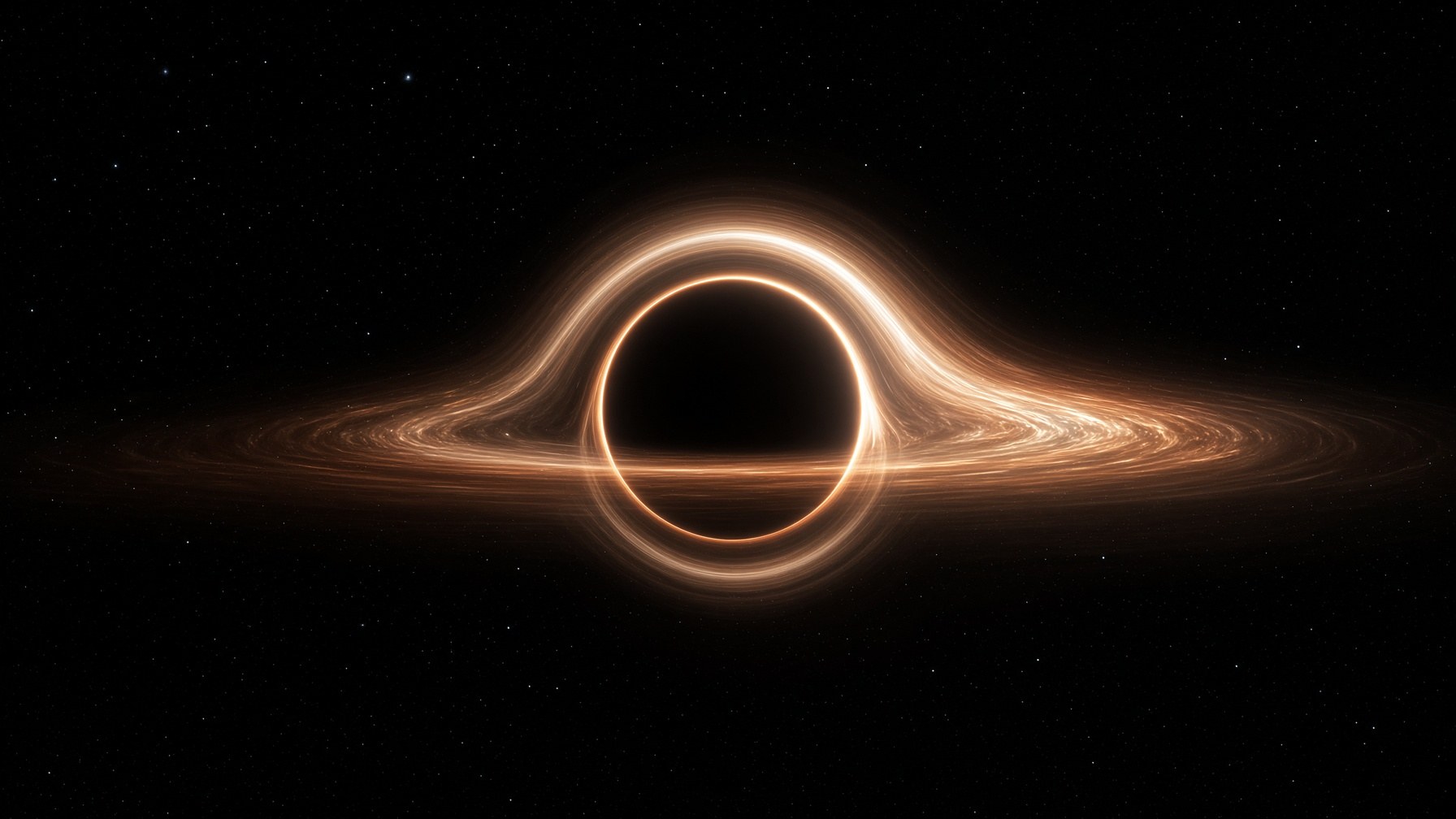
Computed model · Schwarzschild · a* = 0
The disk of darkness is the region from which light cannot climb out: a surface in spacetime, not a photograph of an object. The gold ring is a photon orbit: light that can almost circle forever, sitting at 3M, outside the darkness.
Hard · calculated
Hawking radiation
In 1974 Stephen Hawking showed that quantum fields on a black-hole spacetime imply a thermal flux to infinity. In other words: the hole slowly glows, and in theory can shrink away. The temperature falls as the mass rises (inversely proportional), and the entropy scales with the area of the horizon, matching Bekenstein’s earlier insight.
Taken seriously, a black hole evaporates. The radiation, in the original calculation, looks thermal. Thermal radiation does not obviously carry the details of what fell in.
TH ∝ 1/M · S = A/4 (Planck units)
Hard · open scientific question
The information question
Quantum mechanics is unitary: the full story of a closed system is not supposed to disappear. General relativity’s horizon suggests a point of no return. Put them together and a paradox appears. If the glow carries no details, where did the story go?
Proposed resolutions (complementarity, holography and AdS/CFT, firewalls, islands, replica wormholes) remain active theory. None is a settled instrument reading.
Gravity makes spacetime carry the trace of an event. Whether a horizon can hide a trace forever is still asked, not answered.
Bekenstein 1973; Hawking 1974, 1975. Area law S = A/4 in Planck units. Holographic principle: ’t Hooft, Susskind; AdS/CFT: Maldacena 1997, a precise duality in a spacetime that is not ours. Philosophical treatment: Horizon.