Most astrophysical black holes rotate.
A hole that does not spin is Schwarzschild. Almost every hole in the sky does spin: Kerr. Spin drags spacetime, pulls the innermost stable orbit inward (the last circular path a disk can still hold), and raises the fraction of rest-mass energy a thin disk can radiate before the plunge.
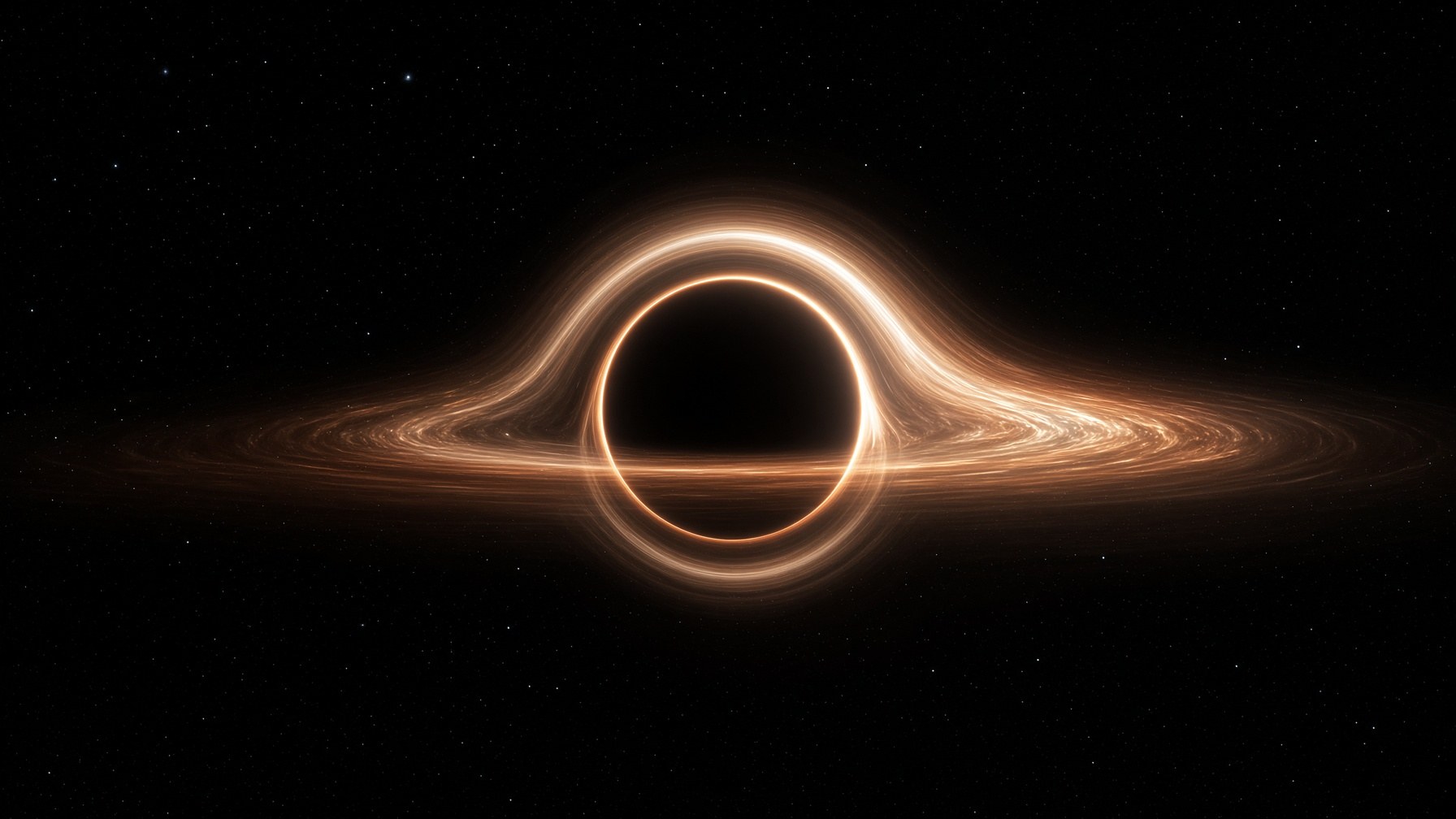
Computed model · Kerr-like lensing field
A spinning disk around a rotating hole. A model, not a telescope image.
Hard · modeled
Drag spin. Watch the last parking orbit move in, and more of the falling matter leave as light.
- spin a*
- 0.700
- last stable orbit
- 3.39 M
- light’s share η
- 10.36%
Hard · calculated
Novikov–Thorne thin disk
A thin, glowing disk of gas, circling until it cannot. Novikov–Thorne thin, Keplerian, radiatively efficient disk. Efficiency η is the binding energy at the ISCO: the share of rest-mass energy that can reach infinity as radiation before matter plunges.
Hard · calculated
Schwarzschild: 1 − √(8/9) ≈ 5.72%. Extreme Kerr (a* = 1): 1 − 1/√3 ≈ 42.3%. Thorne 1974 thin-disk spin-up saturates near a* ≈ 0.998, η ≈ 30–32%.
Hard · calculated
42.3%
Extreme Kerr · a* → 1
If a hole could spin as fast as the math allows, a thin disk could turn about two-fifths of falling matter into light. η = 1 − EISCO at the Novikov–Thorne limit. A theoretical bound, not the usual sky.
Hard · calculated
30–32%
Thorne 1974 · a* ≈ 0.998
Photons captured from a thin disk apply a counter-torque, so a real disk cannot spin its hole all the way to the mathematical edge. Astrophysical thin-disk spin-up saturates here.